
When your business needs funding for equipment or assets, you’ve got a big decision to make: should you go with asset finance or apply for a traditional business loan
Both options give you access to the capital you need, but they work in completely different ways and suit different business needs.
Understanding the differences is crucial for making the right choice that fits with your business goals and financial strategy*
Asset Finance Explained
Asset finance is targeted by nature.
The equipment, vehicle or machinery that you are buying serves as security for the loan.
Essentially, the lender purchases the asset on your behalf.
You pay them back over an agreed period, and during this time you are able use the asset to generate an income through your business.
This direct link between the funding and the asset makes the risk lower for lenders.
This in turn often means better terms for you as the borrower.
Technically, the asset belongs to the lender until you’ve finished paying, but you get to use it fully throughout the finance term.
This setup typically means faster approval and less stringent requirements compared to traditional loans.
You can read more about how Asset Finance works on our blog: How Asset Finance Works: A Simple Guide for Australian Businesses
Traditional Business Loans Explained
Traditional business loans give you an agreed amount of money that you can use for whatever business purposes you have in mind.
There is no direct link between the money borrowed and a specific asset, and this is called an unsecured loan.
Unsecured loans rely mainly on your business’s creditworthiness, cash flow and financial track record for approval.
Once you get the thumbs-up, you receive the full amount as a lump sum and then start making repayments, regardless of how you end up using the money.
Since there’s no specific asset backing the loan, lenders typically see these loans as having a higher risk than the Asset Finance Loans described above.
This can lead to stricter approval criteria, longer processing times and potentially higher interest rates.
Asset Finance vs Business Loans: A Head-to-Head Comparison
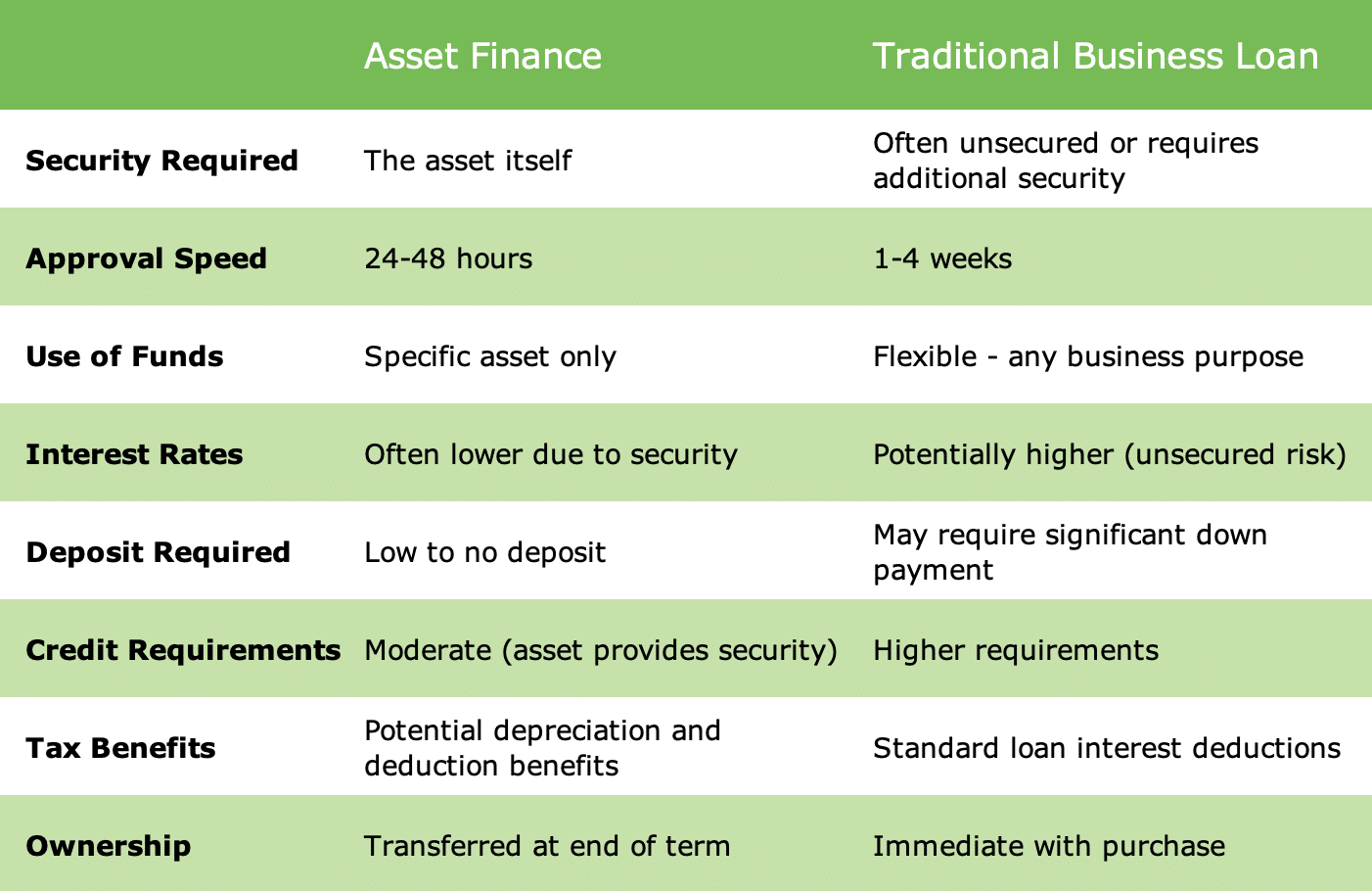
Understanding how these options stack up against each other can help you to make an informed decision about the right finance for your own business.
Here’s how the loans compare across key factors:
When to Choose Asset Finance
Asset finance works brilliantly when you need a specific piece of equipment, vehicles, or machinery for your business operations.
Consider Asset Finance if you:
- Need to keep working capital available for daily operations
- Want fast approval and funding
- Have reasonable credit but need competitive rates
- Need equipment that will start generating income straight away
- Want to take advantage of potential tax benefits
- Prefer lower upfront costs
Manufacturing, construction, healthcare, hospitality and transport typically see value from asset finance as these industries rely heavily on equipment.
When to Choose Traditional Business Loans
Traditional business loans work better for general business needs, where you want flexibility in how you use the funds.
Consider this option if you:
- Need money for multiple purposes (inventory, working capital, renovations)
- Want complete ownership of assets from day one
- Have strong credit and financial history
- Don’t mind longer approval processes
- Need larger amounts that go beyond single asset values
- Prefer the flexibility to change how you use the funds
Making the Right Decision: Asset Finance vs Business Loans
Choosing between these funding options comes down to your specific situation.
Think about what you need right now:
- What are your cash flow requirements?
- What are your long-term business strategy?
If you need a specific piece of equipment to grow or keep operations running, asset finance often gives you the most efficient path forward.
But if you need flexible funding for various business activities, a traditional loan might serve your business better.
At Finch Financial, we help Australian businesses to weigh up their options and choose the financing solution that best supports their goals.
Our team can look at your specific situation and recommend the most suitable approach.
Contact us today to discuss your financing needs and discover how we can help your business access the capital you need to succeed.
Some Frequently Asked Questions We Hear
Which business finance option has faster approval times?
Asset finance typically gets approved within 24-48 hours, while traditional business loans can take 1-4 weeks because of more extensive credit checks and documentation requirements.
Can I use asset finance for second-hand equipment?
Yes, many lenders offer asset finance for quality used equipment, though the terms might vary compared to financing new assets.
What happens if I can’t make repayments on asset finance?
The lender might repossess the asset, but this is usually a last resort. Most lenders work with borrowers to find alternative payment arrangements.
Are interest rates really lower with asset finance?
Often yes, because the asset provides security, which reduces the lender’s risk. However, rates vary based on various factors including your creditworthiness and the type of asset.
Can I pay out asset finance early?
Most asset finance agreements allow early settlement, though some might include early termination fees. Check your contract terms for specific details.
* Please note that this blog is not intended to give advice, but to share information.